
Introducing the State of AI in Spend
What 1,050 leaders told us about AI, ROI, and what’s actually working.

Everyone has a theory about how AI is going to change their business, but when you ask them to explain exactly how, most of the answers come down to vibes.
This spring, we decided to go out and measure it. Zip surveyed 1,050 global procurement, finance, IT, and operations leaders about how AI is actually changing the way they work: what they use, what they've deployed, what it's returning, and what they're planning next. The result is the State of AI in Spend, and it tells a very different story than the one you'll hear at conferences.
What we found, in many ways, confirmed what we suspected. AI is already ingrained in business workflows as a given. 62% of leaders now use AI multiple times a day, while a majority of employees admit to using AI tools their employer never sanctioned. AI is infrastructure now, as unremarkable as email.
The more important story is the way the business case for AI is splitting into two distinct paths, one of which is going to be left in the dust.
The path to AI autonomy divides
Only 17% of organizations report clear, measurable ROI from their procurement technology and AI investments. Everyone else is somewhere between "we see benefits but can't quantify them" and "we're still waiting."
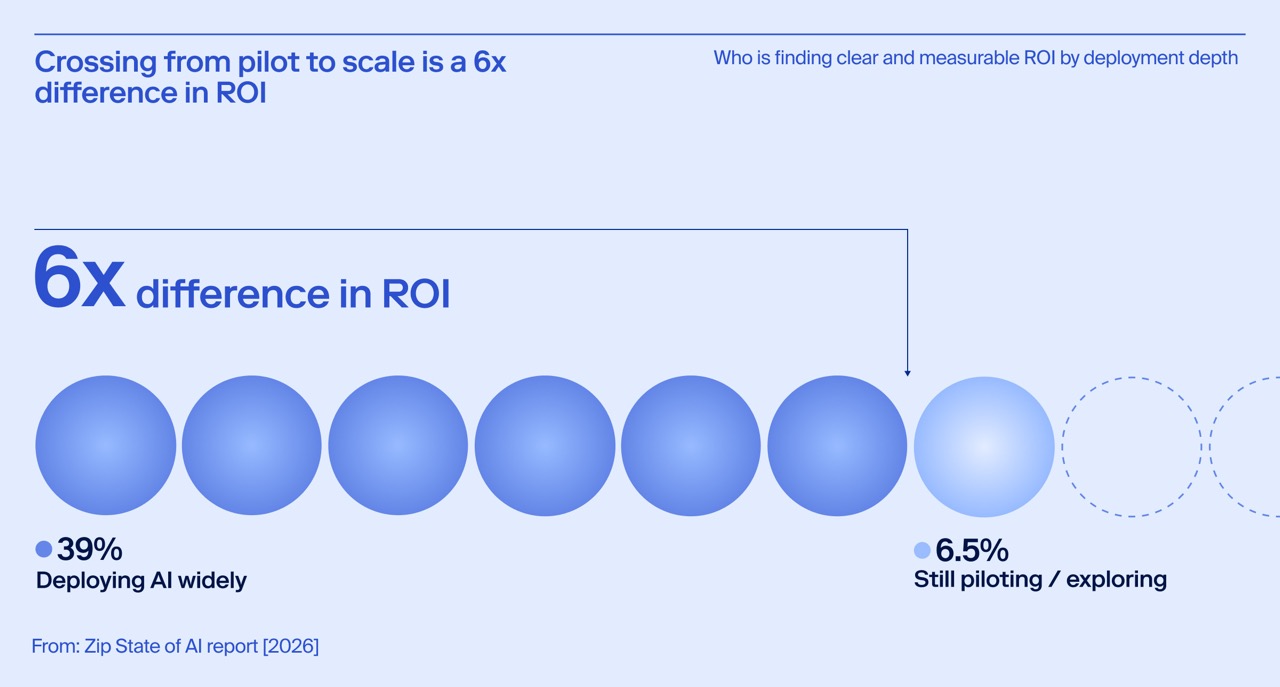
When we looked at what separates that 17% from everyone else, it wasn't budget. It wasn't industry. It wasn't company size. What separates the organizations seeing measurable returns is depth of deployment. They've moved AI out of pilots and into production across their processes.
We call them the Builders. 55% of them are running AI widely across multiple processes; among the organizations seeing no return, that number is 4%. And the gap isn't static; Builders are planning for a fundamentally different future. 79% expect AI to deeply transform their operations within five years, four times the rate of the organizations still on the sidelines.
That's the shape of the data this year. Two paths pulling apart, and the organizations standing still are the ones losing ground fastest.
What's inside the report
The full report goes far deeper than the divide itself. A few takeaways:
- The workforce is recomposing. Builders are restructuring their teams around AI right now, cutting some roles while, counterintuitively, expecting their teams to grow. The single most in-demand skill organizations are building is the ability to evaluate and fact-check what AI produces.
- Procurement's stock is rising. 63% of leaders expect procurement's influence to grow over the next three to five years, and the organizations furthest along with AI are the most bullish. In an AI-driven operating model, someone has to decide where the AI goes, where humans stay, and how the stack connects. Increasingly, that's procurement.
- The middle is unstable. The largest group in our survey sits between the two paths: believers in attitude, pilots in execution. The report breaks down what separates the middle-cohort organizations that are climbing toward measurable ROI from those that are stalling, and the patterns are strikingly consistent.
There's much more inside: how shadow AI became the norm, why planning horizons are compressing, what leaders expect to happen to the procurement tech stack, and how all of this varies by region, function, and company size.
Why you should read the State of AI in Spend
If you're deciding where AI fits in your spend processes right now, this report is a map of where 1,050 of your peers actually are, stripped of the hype in both directions. It shows you, in the data, what the organizations getting measurable value have in common, and how far ahead of the pack they're pulling.
The gap between the Builders and everyone else has widened this year. Every signal in the data says it widens again next year.
Read the full State of AI in Spend 2026 at zip.com/stateofai

%20Large.jpeg)
%20Large.jpeg)

%20Large%202.jpeg)






%20Large.jpeg)



.webp)


AI procurement orchestration, from intake to pay
Enter your business email to keep reading
