
Zip Enterprise AI Index: Where AI budget is actually going
Three vendors take 74% of AI spend, while newer tools gain enterprise adoption.

Welcome to the first edition of Zip's Enterprise AI Index, our data report on how enterprises are buying AI and what business spend says about where the broader market is headed.
Zip has processed more than $1 trillion in enterprise spend, giving it visibility into large purchases as they move through formal approval workflows. Unlike surveys, user counts, or card-based spend data, this dataset shows which vendors are considered, which requests fail, and where approved budgets ultimately go.
The data points to an AI market expanding rapidly but selectively: companies are spending far more on AI and buying from more vendors, while concentrating most of that spend around a small core.
AI budgets are surging but the bar to buy is rising with them
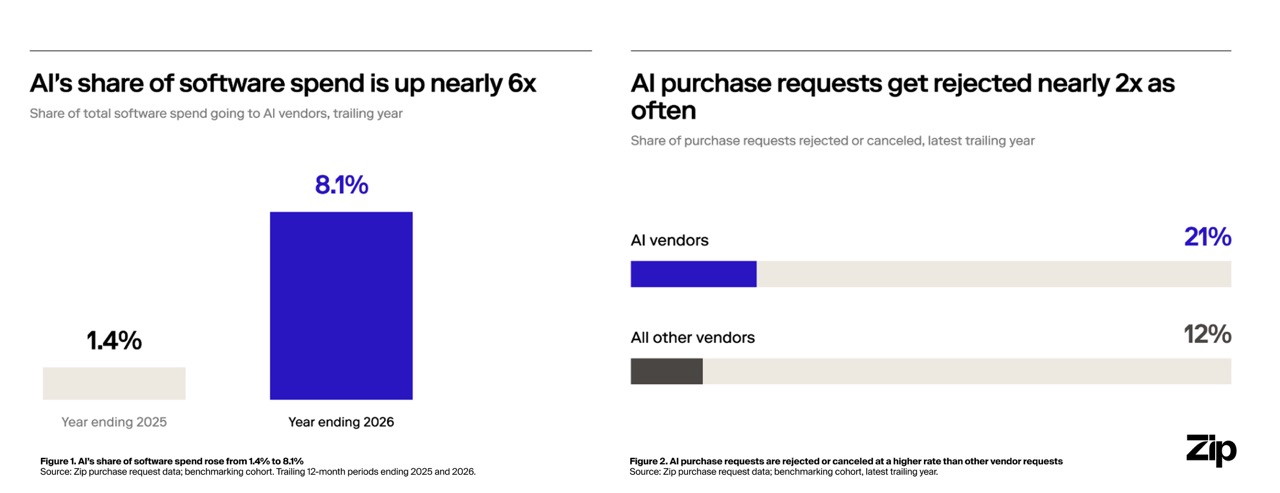
AI is continuing to take a much larger share of enterprise software budgets. Between the trailing years ending in 2025 and 2026, AI vendors’ share of software spend rose from 1.4% to 8.1%. The shift was not confined to a handful of large buyers: 84% of companies observed all increased the share of software spend going to AI over the same period.
But more budget has not meant an easier path through the buying process. In the latest trailing year, 21% of purchase requests involving AI vendors were rejected or canceled, compared with 12% for other types of vendors. The data does not show why individual requests failed, so it cannot distinguish among concerns such as security, cost, duplication or expected returns. What it does show is that enterprise enthusiasm for AI is being accompanied by a materially tougher purchasing filter.]
The AI stack is getting wider, but almost all spend sits with each company’s top three vendors
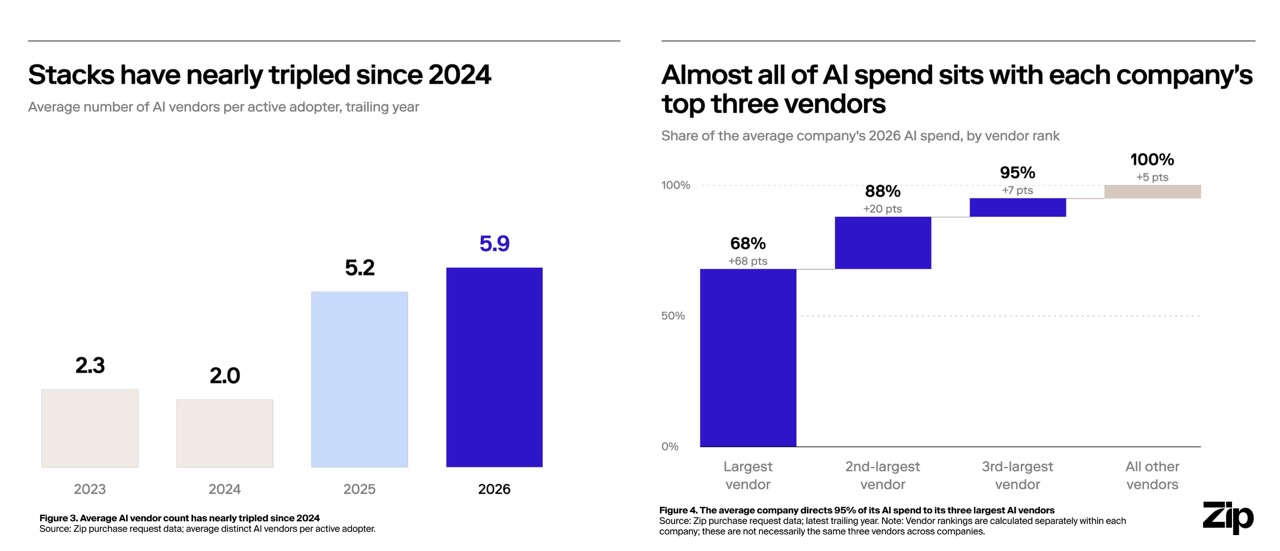
Companies are bringing substantially more AI vendors into their stacks. The average active adopter worked with 2.3 AI vendors in the trailing year ending in 2023, dipping to 2.0 in 2024 before jumping to 5.2 in 2025 and 5.9 in 2026.
The money has not dispersed evenly across those larger stacks. In the trailing year ending August 2, 2026, a company’s largest AI vendor received 68% of its AI spend on average. Its two largest vendors received 88% combined, and its three largest received 95% combined. All other AI vendors shared the remaining 5%. These were each company’s own leading vendors, which differed across companies. Enterprises have moved from one dominant AI bet toward a broader portfolio, but economically that portfolio still has a clear center of gravity: the average company may now buy from roughly six AI vendors, but almost all of its AI budget sits with three.
Aggregate AI spend is concentrated among three vendors
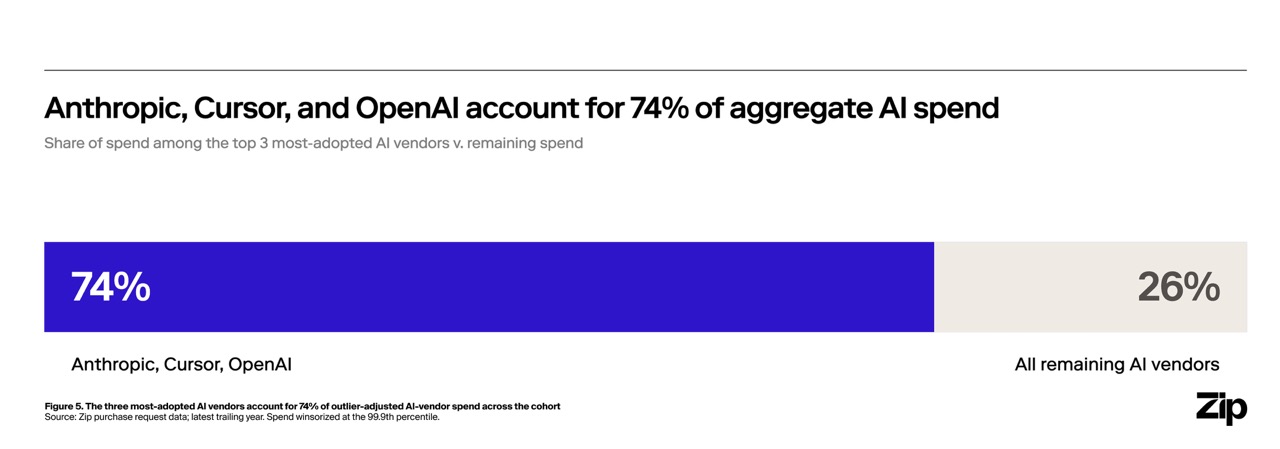
Unlike Figure 4 above, which looks at each company’s own top AI vendors, this analysis tracks the same three named vendors across the full cohort. Anthropic, Cursor, and OpenAI, the three most widely adopted AI vendors in the latest trailing year, accounted for 74% of outlier-adjusted AI-vendor spend.
This leaves only 26% for all other AI vendors. Because this calculation pools spend across the cohort, companies with larger AI budgets have more influence.
The pattern is similar when each company is weighted equally: the same three vendors represented 67% of the average company’s AI-vendor spend. That suggests their share is not driven only by the cohort’s largest spenders. Companies are bringing more AI products into their stacks, but a relatively small group of vendors is capturing most of the spend.
What this signals
Enterprise AI is broadening, but the economics remain highly concentrated. For now, enterprises appear to be concentrating budget around frontier model providers and a small number of high-value applications, suggesting the next phase of the market may be less about adding more tools and more about reducing dependence on the few vendors that currently command most of the budget.
Methodology
This report analyzes approximately $18 billion in approved purchase request value over the past 48 months from Zip customers that opted into industry benchmarking and had sufficient historical vendor data. Participating companies span software, fintech, healthcare, education technology, professional services, consumer packaged goods, financial services, manufacturing and retail.
The sample skews toward larger technology companies: 70% are software or fintech, 89% are based in North America, and the average company has approximately 2,400 employees, with organizations ranging up to 25,000 employees. Among approved requests with a specified amount, the median was approximately $6,900, the average was approximately $160,000, and the largest 1% were worth at least $1.5 million. A vendor was classified as an AI vendor when AI is central to its primary product offering or business model.
Annual comparisons use trailing 12-month periods. Spend figures were winsorized at the 99.9th percentile, meaning exceptionally large purchase requests were capped rather than removed. Market-level vendor shares pool purchase-request value across the cohort. Company-level spend-share calculations measure vendor concentration within each company and then average those percentages across companies, giving each company equal weight.
Learn more about Zip's AI for procurement platform.
%20Large.jpeg)





%20Large.jpeg)







.webp)







AI procurement orchestration, from intake to pay
Enter your business email to keep reading
