
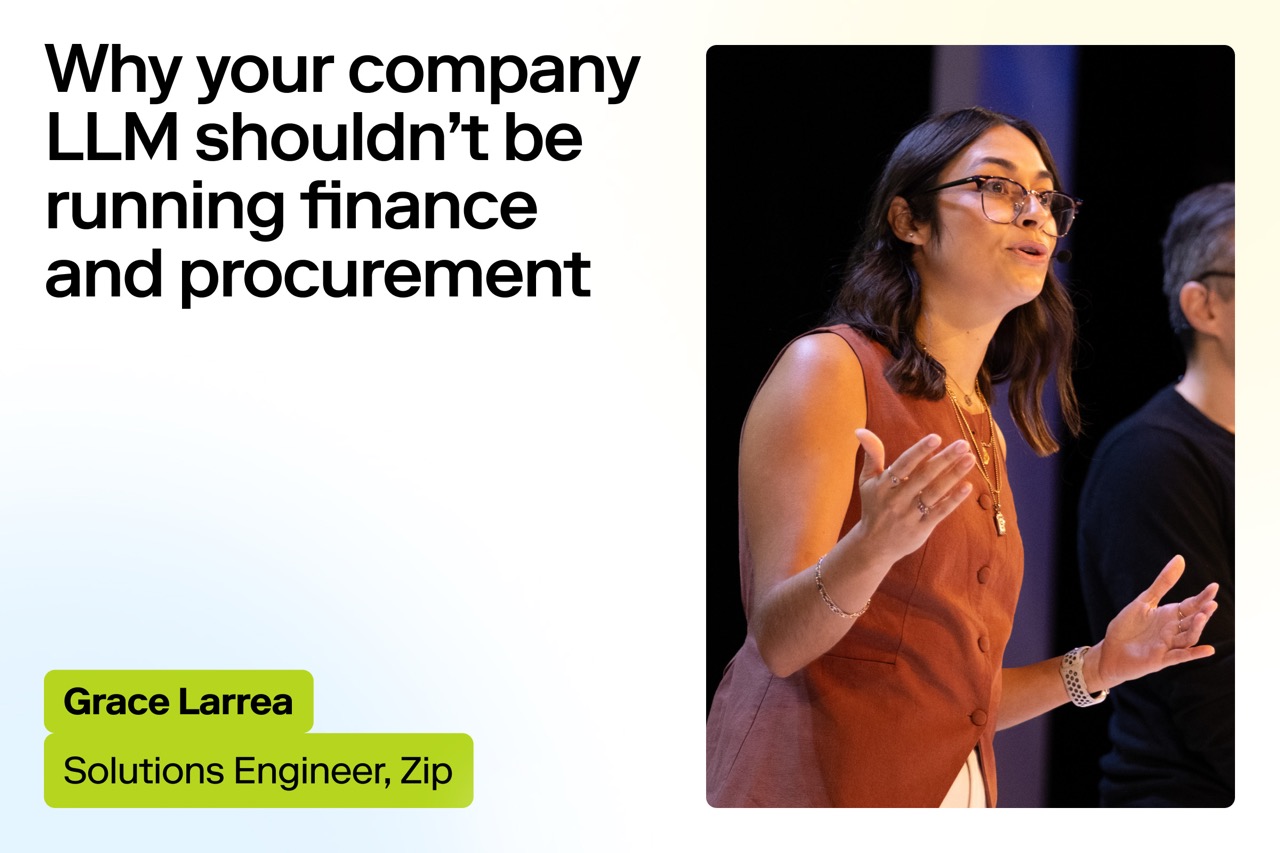
Why your company LLM shouldn’t be running finance and procurement
The build-vs-buy math changes the moment compliance enters the room.

I speak to a lot of growing companies just starting to scale up their finance and procurement workflows, and in this age of AI, one sentiment keeps coming up.
A founder or finance lead looks at Claude, looks at their purchasing workflows, and asks why they should pay for software when this thing they're already using can draft a contract, summarize a vendor, and write a Slack message in 30 seconds.
It's a fair question, and I understand why it's getting asked. For some categories of company, the honest answer is: yeah, maybe you should just do that. Today's frontier LLMs are incredibly powerful and can replace a real chunk of software in 2026..
Procurement and finance are NOT those categories, and here's why.
Shadow AI is a procurement compliance problem
We've seen this problem before. Fifteen years ago, every department was buying its own software, running its own negotiations, signing its own contracts. The solution was centralization: one system, one source of truth, one audit trail.
What's happening now is the same pattern in new packaging. Every employee with a Claude subscription is running their own miniature procurement function. That has real value for plenty of work, but when everyone's running their own bots, there's no guarantee any of them are operating off the correct, latest information.
The pendulum swung from centralized suites, to decentralized point solutions, to decentralized AI instances. That's fine for some functions. It does not work in finance, and it certainly does not work in procurement.
The answer lies in the middle. Procurement orchestration creates a centralized system of record that every agent and workflow runs through, while teams continue to work in their own way. Centralized decentralization. And, most importantly, fully auditable.
What generic AI tools miss for procurement workflows
The intelligence part of the problem has largely been solved. Anthropic and OpenAI's models keep getting better month over month.
The hard parts involve everything else. Four issues I keep coming back to.
Context. Your LLM doesn't know your vendor master, which vendors you tier as critical, what your historical spend looks like, which have an active SOC 2, or which ones failed your last risk review. An adverse media check in a generic tool returns whatever the internet says, and the internet is, famously, not always right.
The same check inside an orchestration platform like Zip compares it against how you've already classified that vendor and how you've handled similar findings before. It has full awareness of context from your entire function. That matters when you're operating at scale, and under the microscope.
Compliance. Uploading business financials into a public AI tool is a data exposure event waiting to happen. SOX-relevant workflows need an audit trail that survives the question "how did this decision get made?" A personal chat history is not that audit trail. It isn't auditable at all.
The ability to take action. Your LLM can tell you what to do. It can draft the message, write the policy, summarize the contract. What it can't do is move the request to the next approval step, create the PO in your ERP, or update the vendor record. Some tools are getting better at this, but none are transparent enough for audit, and it's not a workflow your team should be falling into by default.
Centralized policy. If your governance rules change tomorrow, every employee running their own AI workflow is operating on stale logic until they manually update their prompts. Centralized policy means you change the rule once, and every agent, every workflow, every approval inherits it.
Why this matters more, not less, as AI gets better
A lot of companies are quietly screwed by what's coming. You've heard of quiet quitting? How about quiet compliance loss.
Categories where the entire value of the software was a thin wrapper around well-known workflows are going to get absorbed by the model layer over the next few years.
The companies that survive are the ones operating in domains where compliance, auditability, and the cost of getting it wrong are high enough that you can't vibe-code your way through.
Procurement and finance are those domains. You can't trust a hallucination on a million-dollar contract. You can't put "Claude said it was fine" in front of the IRS. You can't tell your auditor that the third-party risk assessment lives in someone's chat history.
Here's what's actually changed for AI in procurement. The intelligence has been there for a while; the models can already read contracts, summarize vendors, and draft policy. What's new is that AI can now operate inside a system that makes its decisions defensible, with the policies, the context, the audit trail, and the ability to take action that procurement actually requires.
That system is what we built Superagents on. Fully context-aware AI that operates within your governance, with your context, against your policy, taking real action across your stack. Every conversation logged, every action traceable, every decision defensible. Your CFO is going to love that.
It's the difference between AI that suggests how to do the work, and AI that you can actually trust to do it.
Want the deeper read? Our executive introduction to AI Superagents covers what to look for in agentic procurement, how to evaluate vendors, and the operating model shifts your team should be planning for.
%20Large.jpeg)




%20Large.jpeg)





.webp)







AI procurement orchestration, from intake to pay
Enter your business email to keep reading
