
EY: How AI can make human oversight more effective
How to give reviewers the context, expertise and authority to challenge AI.

Human approval is not the same as human judgment, and most procurement workflows cannot tell the difference.
The first question buyers ask about procurement AI is often, “How accurate is it?” A human reviewer feels like the answer. The phrase “human in the loop” suggests that a qualified person will identify a questionable decision, understand it and intervene before the system acts.
That assumption overlooks a problem that already exists in many procurement workflows, with or without AI: a person may be asked to authorize an action without being equipped to evaluate it.
Investment in AI is moving faster than organizational readiness. Within three years, 80% of CPOs say they will invest in procurement AI technology— introducing more autonomous technology into operating models that were not designed to supervise it. At the same time, the EY Work Reimagined research places procurement below the global average for talent health — a measure of employee satisfaction and willingness to recommend their employer. Finance and accounting fare somewhat better, but both functions face the same underlying challenge.
That gap matters because an approval step is not automatically a control. If a reviewer lacks the context, expertise, time or authority to challenge a recommendation, the workflow produces evidence that someone clicked a button. It does not demonstrate that meaningful oversight occurred.
Some of that gap is a context problem, and context problems are the one piece AI can address directly. A reviewer who receives synthesized specialist input — the relevant contract clause, the anomaly in a supplier record, the accounting judgment made by whoever was closest to the transaction — is in a different position than one working from the raw document alone. Capturing that input and presenting it in the frame of the decision the reviewer actually owns is a real, near-term use of the technology.
It does not resolve the other gaps.
Context is not expertise, and information is not authority.
Procurement already knows what rubber-stamp approval looks like
Procurement has lived with phantom oversight long before agentic AI. A contract reaches an executive who was not part of the negotiation. Before approving it, that executive needs to understand what decision they own.
Are they approving the investment, accepting the contract language or accepting the risk it introduces? Without context from the specialists involved, the approval is largely performative.
The same problem appears when an invoice coding exception goes to someone with signing authority rather than the person who understands the accounting treatment. The audit trail records the action; the decision rarely changes. The human action proves that the workflow ran but not that judgment was applied.
The opportunity is to use AI to strengthen human review and close the context gap by bringing relevant context into the workflow and helping the right people focus on the decisions that require their judgment.
Authority is not the same as expertise
Delegations of authority define who may commit company resources and at what threshold. They rarely establish who is qualified to assess a security provision, question an unusual supplier pattern or determine whether an accounting treatment is appropriate.
An executive with authority to approve a large contract is often not the right person to assess what the impact is of nonstandard data access terms. A controller may own the accounting policy without being the person closest to the facts behind a specific transaction. Effective oversight must account for both decision rights and subject-matter knowledge — and they rarely sit with the same person.
AI can help by synthesizing specialist input and relevant transaction data into a more complete view of what is being approved. Human judgment remains important when the decision depends on business or commercial context that the system cannot infer on its own.
EY teams have been encouraging CPOs to consider this shift more broadly: procurement organizations built primarily around roles need to become more fluent in the skills required for the work. Agentic workflows make that transition more urgent. A role-based approval hierarchy asks where someone sits in the organization. A skills-based model also asks what that person is equipped to evaluate.
This does not mean combining expertise and authority in one person. The specialist can assess the issue, the delegated authority can authorize the action and the workflow can preserve both decisions. That separation can strengthen segregation of duties because the review becomes substantive rather than ceremonial.
Effective human oversight is selective
Requiring human review of every agent action can look like the safest choice. At scale, it creates a different risk: reviewers become accustomed to routine alerts and stop distinguishing consequential decisions from ordinary activity. The EY work on AI-native risk functions makes this point clear. Constant, fine-grained review can numb the people expected to intervene.
Some events should reliably stop a workflow. Examples include a high-risk supplier assessment, a change to supplier bank details or an unusual payment exception. Routine activity that falls within established policy may be better governed through monitoring, sampling and performance thresholds.
Organizations are likely to progress from lower-risk to higher-risk use cases as they build evidence around accuracy and become more comfortable with the controls.
Another practical place to begin is with work that teams know they should perform but cannot cover consistently. Adverse media monitoring, broader financial due diligence and checking certificates of insurance against contractual requirements are examples. In these cases, AI expands control coverage rather than replacing an existing human review.
The question is not whether a human stays involved. It is whether the system knows when human judgment is required and gives that person a complete view of the decision. That is the real design challenge behind responsible agentic AI in procurement.
Culture changes when AI becomes part of the work
Making AI tools available does not make an organization AI-forward. Cultural change begins when AI becomes part of how critical work is performed. Embedding it within a governed workflow gives employees a practical way to build familiarity while keeping the use cases defined, the actions observable and the points of human intervention clear.
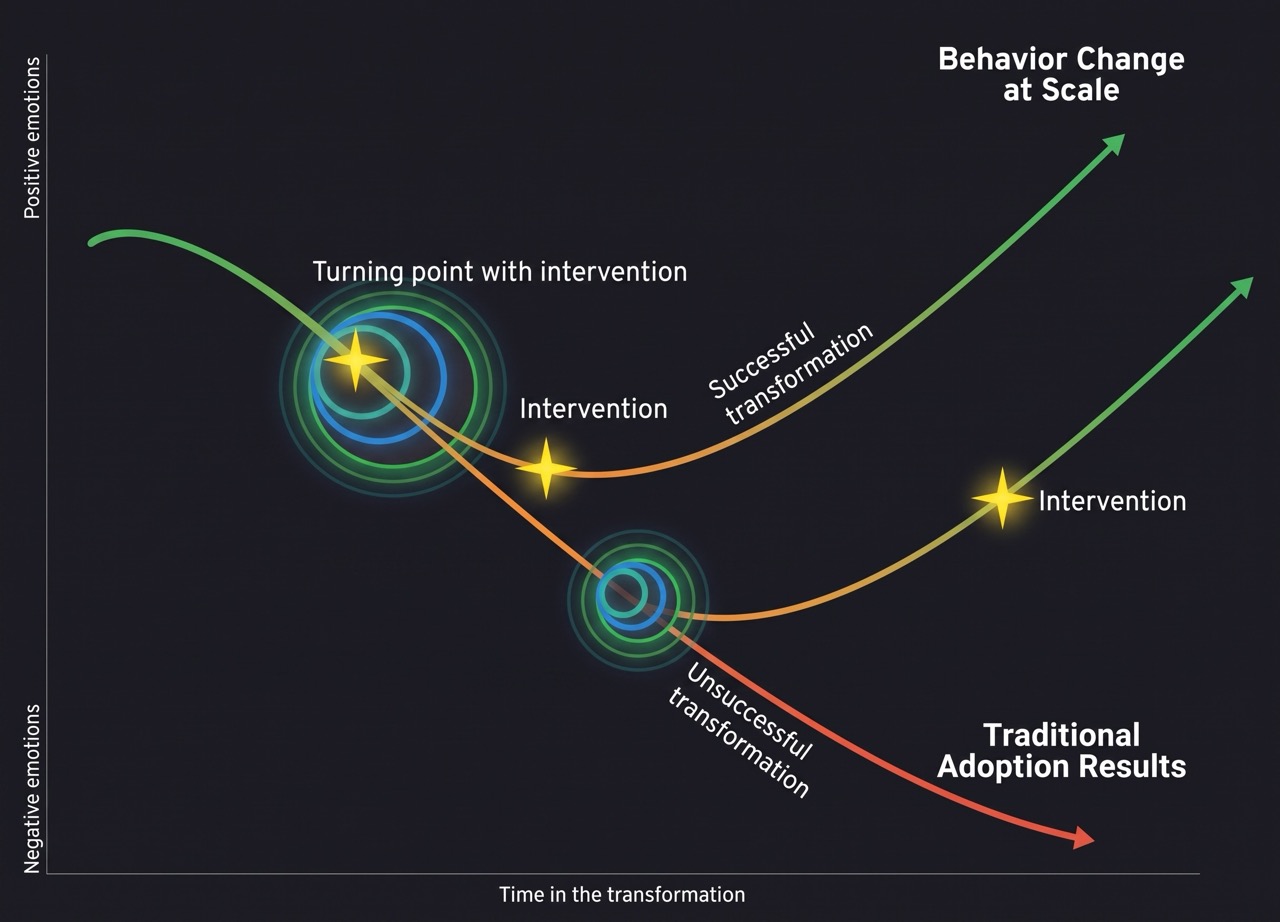
The EY transformation research shows that organizations often reach a turning point after the initial enthusiasm for a new technology fades and the operational difficulty becomes clear. Intervention at that stage can move the organization toward sustained behavior change. Without it, the technology may be installed while the old behaviors remain intact.
In procurement, the missed opportunity is embedding AI into a process without improving how decisions are made.
Human dynamics deserve attention. EY research1 found that 38% of employees fear their jobs will be eliminated and not replaced. A reviewer who sees AI as a threat may defer to its recommendation to avoid appearing resistant. Another may overcorrect by blocking routine actions. Both responses weaken the quality of oversight.
Psychological safety gives reviewers permission to identify when an agent has reached the wrong conclusion. Leaders reinforce it when they treat intervention as evidence that the control is working, not as friction that should be removed.
As employees see AI operating within clear boundaries, they can build confidence in both its capabilities and their own role in supervising it.
Build the loop around decisions, not approvals
An effective human-and-agent model starts with the business outcome and the decision required to achieve it. What should AI surface or synthesize? Where does human business judgment remain essential? What can the agent do independently and which conditions should require it to stop? The goal is to improve the decision, not simply automate another task.
The answers then have to be reflected in the workflow. Policy should distinguish routine activity from genuine exceptions. When an exception occurs, AI should bring together the relevant business context, specialist input, applicable policy and checks already completed. The final approver should not have to reconstruct that context from a contract, invoice or request alone.
Feedback matters too. If reviewers repeatedly overturn the same recommendation, the organization should be able to identify the pattern and improve the rule, model or policy behind it. Otherwise, the human is compensating for a recurring weakness rather than helping the system improve. This also turns confidence in AI accuracy into something the organization can evaluate through evidence rather than assume.
EY teams help organizations identify where AI can create value, redesign work around those use cases and guide employees through the resulting change.
Zip embeds governed AI into intake-to-pay workflows, where procurement policies and decision rights become day-to-day operating practice.
Together, these capabilities can move AI from an optional tool to part of how procurement operates.
Measure whether the loop changes outcomes
The number of human approvals is a poor measure of AI governance. It rewards activity without showing whether the control worked.
CPOs should instead ask whether the right exceptions reached the right people. Did reviewers receive enough context to challenge the recommendation? Did intervention happen before the action became difficult to reverse? When a reviewer found a problem, did the system improve?
Those governance questions should sit alongside business outcomes. A well-designed model should improve commercial decisions, expand coverage of risk activities that teams cannot perform consistently today and protect cycle time. It should also give procurement professionals more time for category strategy and supplier management instead of adding another queue of low-value approvals.
“Human in the loop” remains important, but a human click is not the objective. Better decisions are.
AI can help by bringing the right context to a qualified reviewer and by extending oversight to activities teams cannot perform consistently today. That is the standard procurement leaders should design for as agentic AI begins operating at scale.
About EY
EY is building a better working world by creating new value for clients, people, society and the planet, while building trust in capital markets. Enabled by data, AI and advanced technology, EY teams help clients shape the future with confidence and develop answers for the most pressing issues of today and tomorrow. EY teams work across a full spectrum of services in assurance, consulting, tax, strategy and transactions. Fueled by sector insights, a globally connected, multidisciplinary network and diverse ecosystem partners, EY teams can provide services in more than 150 countries and territories. All in to shape the future with confidence.
EY refers to the global organization, and may refer to one or more, of the member firms of Ernst & Young Global Limited, each of which is a separate legal entity. Ernst & Young Global Limited, a UK company limited by guarantee, does not provide services to clients. Information about how EY collects and uses personal data and a description of the rights individuals have under data protection legislation are available via ey.com/privacy. EY member firms do not practice law where prohibited by local laws. For more information about our organization, please visit ey.com. Ernst & Young LLP is a client-serving member firm of Ernst & Young Global Limited operating in the US.
© 2026 Ernst & Young LLP. All Rights Reserved.
US SCORE no. 32670-261US
2609-11535-CS


















AI procurement orchestration, from intake to pay
Enter your business email to keep reading
